Wednesday, July 29, 2015

One Fish, Two Fish

It's safe to say that we have red fish and blue fish on day 2 of fish. Blue? Fine, maybe not literally blue, but it is called Blue Fin Tuna. Whatever. Also, white fish.

On day 1, Chef did a demo of a salt crusted sea bass. I can't imagine anyone actually makes this at home, but it is a great technique and a really great table side presentation.

First, we toasted crushed black peppercorns and coriander seeds. Then, we coated the inside of the (whole) striped bass with the spice mixture. We then placed sliced lemons and fennel inside the fish cavity.
Here comes the good party. We mixed an ENTIRE box of kosher salt (read: an entire box of kosher salt) with a couple of egg whites to help hold the mixture together, and lined the pan with some salt. We placed the fish on top of the salt and then completely smothered the fish with the salt mixture.

When the fish is cooking in the oven, it's not baking. It's steaming. The salt creates a seal and ends up steaming the fish inside. After it's out of the oven, you peel off the salt and take out the fennel and lemon, and serve the fish that's been steamed. And, spoiler alert: The fish is not at all salty.

Another dish we did on Friday (delayed post) was a Vera Cruz. This was one of the (many) times that Chef has given all of us an entree to make and told us that we have to have a complete dish by the end of the day. So, on top of a new recipe we're making, we need two other dishes to worry about as well.

One of the hardest things to do in the kitchen (according to Chef) is to grill a fillet of fish. So, he gave us the option to saute the fish or bake it, but you know me, I needed to tackle the grill. I wanted to get the grill marks to come through on the dish. Also, I wanted to try the challenge of grilling a very delicate piece of fish. Game on.

So, I dredged the fish in flour, shook off the excess, and then dipped it in a bit of high temperature oil. Then, my heart started pounding and my hands started shaking. Keep the fish on for 2 seconds too long, and it'll fall apart on grill, Chef said. With his voice echoing in my head, I put the fish on the grill and counted to twenty, gently picked it up with tongs and cross hatched it for another twenty, quickly took it off the grill, onto a sizzle plate, and into the oven.

We started the sauce which has a tomato base, some cinnamon sticks, olives, and capers. It had some interesting mixture, to say the least. We got the sauce going in a pan, and once it was boiling, took the fish out of the oven and sent it for one final swim.

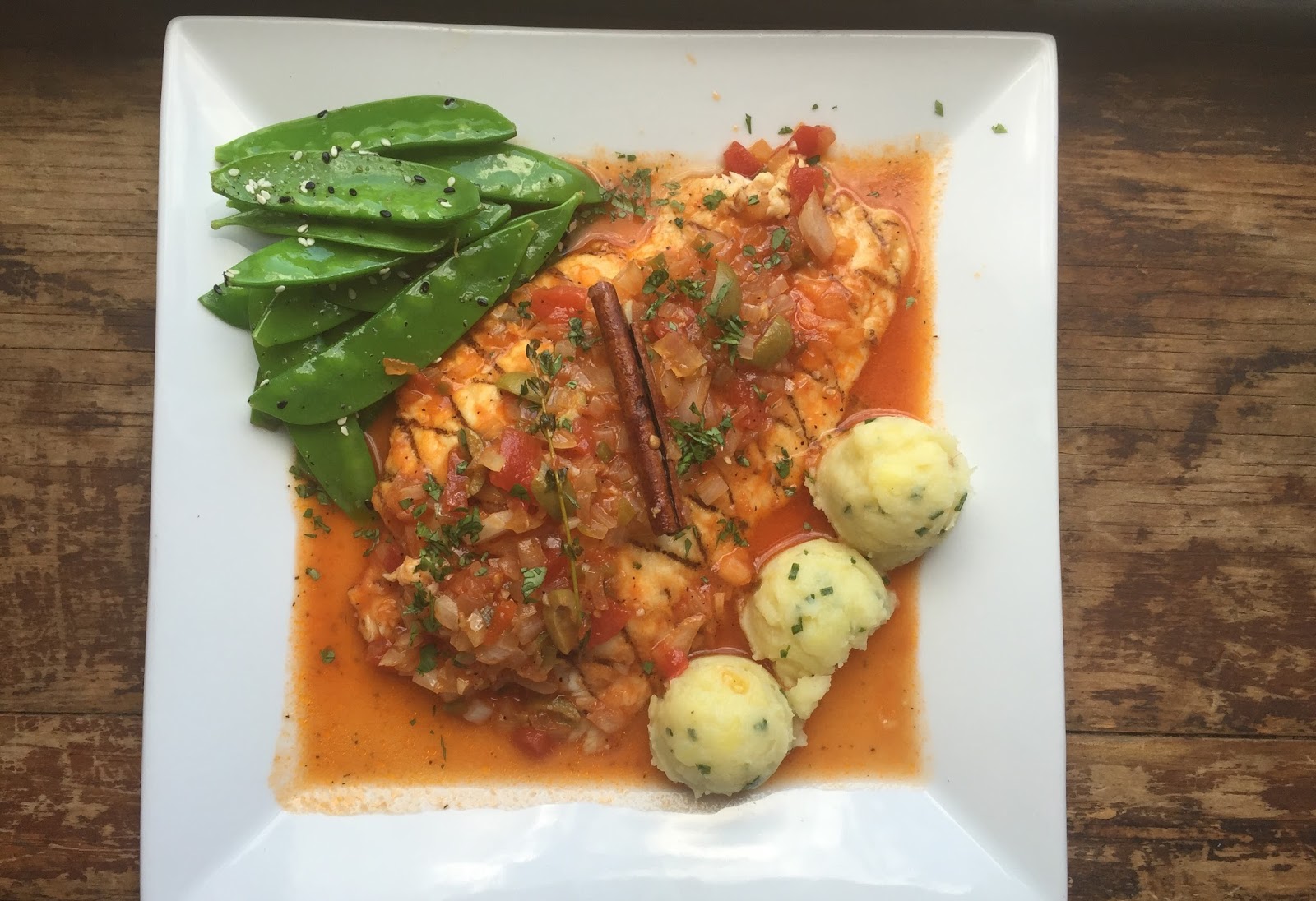
My finished plate looked like this:
Notice the grill marks, please. I worked very hard on them. For a full forty seconds. Also pictured: celery root and potato mash with chives and sesame oiled sugar snap peas.

Tip of the day: When grilling fish. Don't mess up. Work quickly and gently. You only have to grill one side (the presentation side). When putting the fish on the grill, make sure to put it presentation side down. This means that the skin side will be on top. Always season your flour before breading any protein. Salt, pepper, and an herb should do the trick.

Sunday, July 26, 2015

If you can't take the fish, get out of the kitchen

Fish day. Gross, right? Well, gross for a reason different than you think. When Chef told us that fish day(s) were coming up, we all made the face. The same face you're probably making right now when you're thinking, "Ugh, really? I have to read about fish for the next couple of days?"

Turns out, fish only smells like fish when it's not fresh. So, I walked in on Thursday morning thinking the place was going to reek of fish, but I was so wrong! We had the whole room filled with whole, striped bass, and the place didn't smell at all! Promise.

The first thing we did was meet our fish.
Poor guy, never saw it coming. I'm not going to show you the "after" pictures, because it's pretty gross, but trust me: I. Filleted. This. Fish.

On day 1, my buddy and I were asked to make a ceviche. Well, I think we kinda volunteered. I was interested in making it since I'd never had ceviche before.

For those of you who don't know, a ceviche is, essentially, raw fish which is marinated in an acid that cooks the fish. The texture of the fish in a ceviche is like raw fish, so if you're not into that, I don't think ceviche is for you.

The recipe for the ceviche is similar to that of a pico de gallo: diced onions, tomatoes, serrano pepper, and, of course, lots and lots of lime juice.

First, the fish was marinated by itself in the lime juice, for about an hour. Then, we added the mise en place and it continued to marinate together.


One of my classmates walked in on fish day and told Chef, "Chef, I'll cook the fish, but I really really don't like fish at all. It's so fishy." Without even blinking he said, "you've been eating old fish." By the end of day 2, she said, "Chef, I can't believe you made me like fish."
Tip of the day: We've already spoken about the freshness of fish. If you want to buy fresh fish, don't buy the stuff that smells like fish. For the freshest fish, go to a fish market or store, look for a whole fish with the reddest gills, and ask them to fillet it for you. That way, you know exactly what you're getting. Often times the fish you get at the supermarket can be close to two weeks old. 

Home in time for the Hollandaise

We continued last week (sorry for the late post) with no meat, since the 9 days end today (yay!). After learning about emulsions (temporary and permanent) we needed to learn about the classic Hollandaise and Béarnaise sauces.

The largest part of a Hollandaise is butter, so the success or failure of the sauce depends not only on skillfully combining egg yolks, water, acid, and butter into a rich, creamy sauce, but also on the quality of the butter itself. Unfortunately, we could only use clarified margarine, since we cook in a meat kitchen, and Jewish law prohibits cooking meat and dairy together. Even though we used margarine, we still got the idea of the sauce. I was really excited to be making it since it's something that I've never had before. Little did I know that this was going to be quite the workout.

In general, the ratio of egg to butter is 1 yolk to every 2-3 ounces of butter. The more eggs you have, the more butter the sauce can handle.

An acid is also added to the sauce for flavor and to help the eggs hold the butter together. The acid can be either a vinegar reduction and/or lemon juice. In our case, we used both. We reduced the vinegar with peppercorns to make a strong, concentrated flavor.
And then, the real work started. I combined a few egg yolks and started whisking them in a large metal bowl by hand. Slowly, I added the vinegar reduction and (continuously whisking) brought the bowl over to a pot of boiling water. I rested the bowl on the pot of water and continued to furiously whisk the eggs and reduction. It was really tricky because you don't want your bowl to get too hot that the eggs start to cook; we don't want to have scrambled eggs on our hands. You also don't want to mixture to cool off too much, either. So it was an aerobic effort to keep my eggs at the desired temperature. On, off, whisk, on, whisk, off, on, whisk. I was so tired. My arm was killing, my wrist was aching, but I did NOT want to be the one who broke a hollandaise. Chef said he was going to make an example out of the broken sauce and show us how to fix it. But I certainly did not want mine to be the example.

Once I got the eggs thick enough (like ribbons, whatever that means), it was time to add the butter. (I'll just call it butter here even though we used margarine, because, gross). I had the measured out butter next to me and, while whisking with my right hand, I slowly streamed in the butter with my left, making sure that as soon as the butter hit the eggs, it was whisked in immediately. As I was whisking, I noticed my sauce was a little thick, so I added a few drops of boiling water just to thin it out a little. Finally, I was able to stop whisking. I tasted and added salt and a little cayenne pepper, and squeezed some fresh lemon juice in there as well. Because we were using margarine, the taste really came through, so I used more vinegar reduction than was suggested, and I squeezed a bit more lemon at the end, and I really liked the result. It was a bit less "margarine-y" than the others.

A Béarnaise sauce, while very similar to the Hollandaise, has a tarragon and vinegar reduction, and with white wine instead of lemon juice.

We also got started on a risotto, which is a rice that needs love for 25 minutes straight. We used dried shitake mushrooms, and placed them in a bowl with boiling water and consume mix (so it would remain parve).

I sauteed finely diced onions in a saute pan for a minute or two, and then added the rice. I mixed the rice until it started to toast a little, and then slowly added the consume/mushroom water (without the mushrooms). I added a cup at a time, and continued to mix the rice until the liquid was absorbed, and then I added another cup, absorbed, and repeated.
I added the mushrooms once the rice was tender, and also added a splash on truffle oil for the aroma. Seasoned with salt and pepper and turned off the heat.

Meanwhile, I had blanched some broccoli rabe, which is naturally very bitter tasting. The bitterness can be removed by adding some acid, like lemon juice, and I added some crushed red pepper flakes, too. The broccoli rabe was chopped up and reserved to be put on top of the mushroom risotto.
This is a nice vegetarian dish that I can make for all of my vegetarian friends. I do have a few. Hi girls!

Tip of the day: When whisking a Hollandaise or a Béarnaise, you're arm is going to want to fall off if you use your upper arm strength to mix. The trick is, it's all in the wrist. This goes for pretty much any whisking work you'll need to do by hand, not just for a Hollandaise. Use your wrist for all of the whisking and you'll be able to stand it for much longer.  

Tuesday, July 21, 2015

It's just the tip of the iceberg

Since this week we're cooking a lot during the 9 days (a period of mourning the destruction of the first and second temples) and traditionally Ashkenazi Jews don't eat meat or poultry during this time, Chef had to get creative with our schedule this week.

Yesterday and today were salad days! Now, you may ask, why two days for salads? Can't you just follow a recipe for a dressing and put some vegetables in a bowl and toss? Why, yes. Yes you can. But you can also do a ton of other things.

First things first. What is a salad? The first thing that probably comes to mind is lettuce, raw vegetables, and a dressing. That isn't wrong. But is it right? What about a fruit salad? Tuna salad? Pasta? Sushi salad? I could go on.... Potato salad? Rice? Corn? Come on, people. We can come up with more. But more importantly, can we come up with a definition of a salad? Anyone have any ideas?

Yesterday we went through some different types of salads:

  • Tossed Salad- Lightly covered with an oil and vinegar dressing
  • Composed Salad- Each item on the plate as its own place and is individually seasoned
  • Bound Salad- Something like a tuna or egg salad that is bound by mayonnaise, yogurt, cream cheese, or sour cream, etc.
We spoke about emulsions, where two or more items that don't want to go together (like oil and vinegar) are forced together. We also went through different types of emulsions:
  • Temporary emulsion- Something like a vinaigrette (2/3 oil and 1/3 vinegar) are mixed with herbs and spices and is shaken just before serving.  
  • Permanent emulsion- Something like a mayonnaise or aioli. Permanent emulsions have something which holds the oil and vinegar together like egg yolks or mustard. These are whisked pretty hard in order to make it thick. The thicker it is, the more flavor you can add to it. 


When making any type of dressing, add all the other ingredients together first, and then drizzle in the oil like I did above.

We made a tossed salad yesterday, with jicama (tastes like a blend of an apple and a potato), red onion, and oranges with a poppy seed dressing. All of the ingredients were tossed together to create a great appetizer:

The martini glass rim was lightly dipped in egg whites and then dipped in poppy seeds to make this adorable presentation. Come on, how cute?

Today was about composed salads. A classic composed salad is a Salad Nicoise. In this salad, Chef told us that there are a bunch of ingredients that are a "must," such as hard boiled eggs, potatoes, tuna, green beans, red onions, olives, cucumbers, and tomatoes. Again, every component on this dish has to be seasoned or presentable on its own since the salad is not all tossed together.
Even though salads are simpler than, let's say, making pasta from scratch or making a soup or lamb chops, this is probably a plate of mine that I'm proudest of. I crusted the tuna with peppercorns and coriander seeds, got a pan white hot, drizzled oil on the tuna (not the pan) and placed the tuna, one side at a time to sear in the pan. You want your pan so hot that the tuna sizzles and whistles when it hits the pan. The potatoes and cucumbers were marinated in the vinaigrette for a few minutes, the tomatoes were cut brunoise with basil chiffonade and seasoned with salt and pepper. The green beans (which are under the tuna) were blanched in heavily salted water and shocked in an ice bath (to keep the bright green color), and the lettuce under everything was lightly tossed with the vinaigrette before everything else was placed on top.

Tip of the day: When choosing a lettuce as your base, think about the bitterness or sweetness of it and how it'll pair with your dressing. For example, our bitter lettuces are romaine, radicchio, and endive (to name a few) are paired well with a sweeter dressing, so look (or create) dressings with sugar, honey, or agave in them to help balance out the bitterness of the lettuce. 

Sunday, July 19, 2015

Udon even know..

I've always wanted to make my own pasta but I don't have a pasta machine nor do I have the best kitchen. But, the pasta few days were really fun since we got to make it from scratch! Not only that, but we also made vegetable pasta. You know the boxed noodles with green and red pasta? We made that.

First, we put the flour in a bowl and made a well and put the eggs, oil, and water in the middle.
Then we kneaded the dough into a ball until it was no longer sticky and hid it under a bowl so that the air wouldn't make the dough hard while it sits.
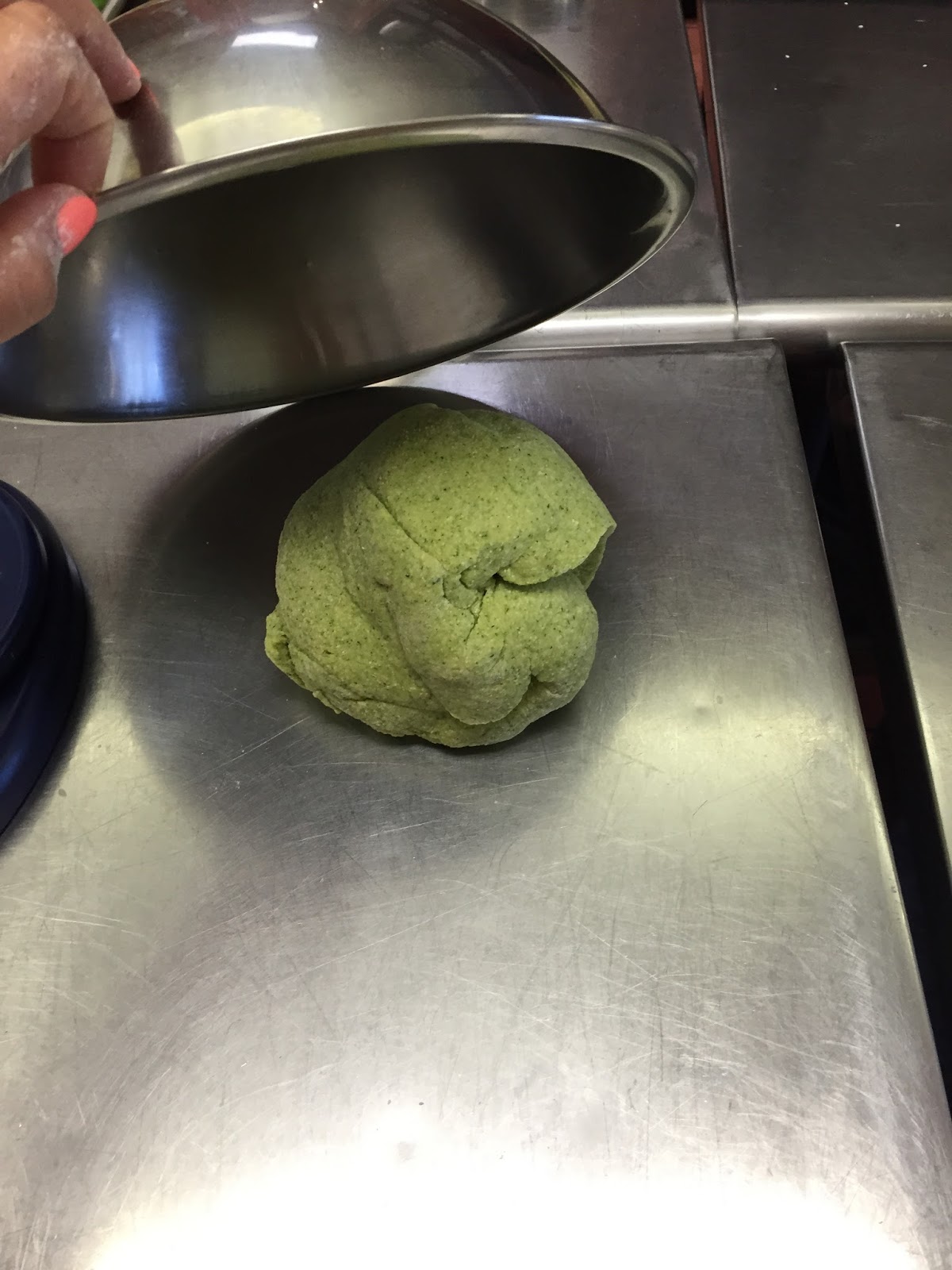
Here comes the broccoli pasta! I blanched some broccoli, strained it, and then put it in a few layers of cheesecloth and squeezed all of the liquid out. We put the broccoli into a food processor with flour, eggs, and oil until it made this green dough:

Back to the regular dough, we rolled it out and then folded it into a rectangle and then rolled it out again. Then we put it through the pasta machine at least 7 times, each time changing the setting so that the dough kept getting thinner. Then we ran it through to slice it into fettuccine.  
And we also made marinara sauce and pesto sauce to make these delicious dishes!

Tip of the day: If you're starting to cook a lot of dishes in one shot and you think you'll need a pot of boiling water for a few purposes, fill up a big stock pot with water at the start of your cooking. Work on other things while it gets to a boil, and then use that pot to get water for smaller pots of boiling water so you don't have to constantly wait for your water to boil. This really came in handy on Friday when I was scrambling in the kitchen (thanks, FDR traffic), and I needed to blanch some green beans and corn but didn't want to wait for the water to keep boiling for each time. So, when I got home, I put up a huge pot of water, and started cutting the root vegetables, and then took a smaller pot to scoop up some boiling water to use for the string beans and then another one for corn. It was a real time saver!

Wednesday, July 15, 2015

Sorry, Mary

Lamb. Chops.

Today was day 2 of lamb day... Day 1 was butchery, so I didn't think y'all wanted to be a part of that. Yesterday we each cleaned and cut lamp chops and today we learned about how to prepare them to deliciousness.

The first thing I did was crack white peppercorns (using a skillet as my masher). I also got out some dried rosemary and crushed that up a bit. Once I had my spice mixture, I coated my lamb chops with it, and then smothered it in high temperature oil (like canola).

Then, I got my pan hot. Hot hot hot with no oil. So, I have a scorching hot, empty pan, and I have meat which is coated in oil. Once I knew my pan was hot, I started to sear my lamb chops.


After I got a good sear on each side of the chops, I placed them on a sizzle plate (which is basically an iron plate that goes in the oven...I've been using them every day and I kind of can't remember what it was like to cook without them), and placed the chops in the oven. For a rare cook, Chef says they should be in the oven for about 20-25 minutes, turning them over once about half way through. The problem today was that 5 other people were using the same oven, so the door kept opening and closing and the heat did not remain consistent. So, it took me a little longer.

While the lamb chops were in the oven, I got to work on my tarragon sauce. This sauce is a brown sauce, so you know we used the veal stock sauce that we made last week. Tarragon sauce is made up of dry vermouth, white wine, tarragon (duh), shallots, and demi glace (the veal stock sauce we made last week). The sauce wasn't coming out the way I wanted it to; it was a bit too thick and strong. Whenever you have a sauce that's too thick, you can always thin it out with more stock. That way, the taste of the sauce doesn't get diluted with water since the stock that you're adding has a ton of flavor.

We were also responsible for a starch and a vegetable for the plate. My buddy and I teamed up to make smashing mashed potatoes, complete with a full head of roasted garlic, sauteed onions, and a lot of love. Yum.

I found a recipe for french peas. I know, I know. How lame? I wanted to make them because peas are something I never cook, and this summer is all about going out of my comfort zone and trying new things and new tastes. Would I order peas in a restaurant? It's not a baad choice but I probably wouldn't. But now I know that peas go well with sauteed Boston lettuce (or green cabbage since we didn't have Boston lettuce today), and that they need sugar in thickener to bring out the sweetness.

The result?
Sorry for the ugly presentation. For some reason, the picture of my finished plate didn't come out well, but here I get to sheer with you what I had for dinner tonight.

In my humble opinion, the crust on the lamb was a bit too peppery and I would definitely tone it down on the pepper and crank it up on a mixture of other herbs and spices. But after everything, I don't think I'd ever had lamb chops before. And let me go out on a lamb here and say that it was so much fun to slave over them from fabricating to searing to cooking to plating to eating!

Tip of the day: When sautéing or searing things on a fire, use a high temperature oil that won't burn up very quickly. I know we've all gotten used to using olive oil because it's healthier, but the darker the oil, the lower the cooking temperature. Canola oil and other light oils can be used to saute or sear at a very high flame without burning. But hey, I'm not your mother. Use a darker oil. I dare you.  

I'll sheepishly admit it: Lamb puns are baad news. Good thing ewe wool not have to suffer through this any longer. 

Monday, July 13, 2015

What are you, chicken?

The past two days have been poultry days and Poultry Day 1 was Identification and Fabrication, i.e., butchery and whatnot. I have to say, I'm not completely disappointed that I missed Friday's butchery class. I know this class is designed for chefs who are probably buying their chickens whole, but I plan to continue to buy my chickens already butchered. Amen.

Poultry Day 2 was a little more my speed: cooking the bird. I'm down with that.

Chef has been telling us that there are two ways to cook. The wet and the dry. Wet cooking would include boiling, simmering, blanching, or poaching. Basically, any cooking with liquid, except oil. For some reason, frying in oil, even deep frying, fall into the dry cooking category. Dry cooks include baking, broiling, grilling, and frying. Then we get into the fun stuff: Combination cooking, otherwise known as..... anyone? Anyone? Braising.

Braising includes a dry and a wet cook. Today we made Chicken Cacciatore, which falls into the category of braising, apparently.

We dredged the chicken (on the bone) in seasoned flour, shook off the excess, and added it to a saute pan with hot oil. Starting with the skin side down (even if there's no skin on the chicken), we pan seared the chicken (dry cooking) just to get a nice golden brown color on the bird. Once the color came out nice, we removed the chicken from the pan, but kept all the goodness, or fond, or leftover drippings in the saute pan and added onions, mushrooms, tomatoes, chicken stock, demi glace, and seasonings. You guessed it, this is the liquid that will finish off the chicken. We brought the sauce to a boil, reduced it a bit, and added the chicken back to the pan.

Oh, what fun it is to flambe! That's right, it's amazing and terrifying and awesome and terrifying. But, I must give the class credit: the building still stands.


The brandy is what makes it flam and the white wine is what makes it bay. (I don't think that's actually a thing).

The thing that's great about the kitchen at school is that all of the saute pans are oven safe, too. I don't have that at home and I'd love to be able to put my pans in the oven (hint, hint). Anyway, we covered the pan tightly with a lid and put it in the oven for 25-30 minutes,turning the chicken over after 15 minutes [insert arm burn here].

My Chicken Cacciatore looks a little something like this:

De. Lish.

Then, Chicken Milanese! Named for the city of Milan, this chicken bares a striking resemblance to The Schnitzel. But, I assume we can't call it a schnitzel in this context.

We took a chicken cutlet and butterflied it so it opened up and was very thin. Not thin enough, I guess, since we beat the heck out of it to get it even thinner. Paper thin. Used an English breading station (flour, egg, breadcrumbs), and then pan seared it to get a golden brown color, and finished it off in the oven for 5 minutes. We had each individually prepared a tomato salad and an arugula salad which is frequently paired with schnitz.. I mean, with Chicken Milanese. When the chicken was ready, I sliced it into thick pieces, and plated it like this with my salads:

Tomorrow we start lamb! Yum! Butchery? Not so yum. But I hope we'll get to the good stuff soon enough. 

Tip of the day: When adding something to a pan of popping oil, always place the food in the pan in a motion that moves away from your body. This way, any pops or splatters will be aimed at the wall behind your stove and not at your eyes. Unless you want fancy eyes.