I always knew that there are a lot of people out there who don't eat veal, but I never really understood why. Just because it's a baby animal? But people eat pargiyot... so I never really understood what the difference was. Until today.
Just a disclaimer: I am pushing no political agenda here, nor do I think that my teeny little blog is powerful enough to change anyone's mind. The following information is just that: information.
The thing about veal is that it is a vender tender meat. It's tender because it comes from a very young animal. Most of the time no older than a year old. Young animals do very little exercise, so they build very little muscle, so their meat is tender. In the past, they've kept the animals in very small pens so they didn't have any room to move around and exercise. There were even animals that had their feet nailed to the ground so they couldn't move. The animals raised for veal are also only fed milk. Once they eat grass, they get more iron and their meat turns red. So, they keep them on a dairy diet. The animals are also raised in the dark so they become anemic. When they're anemic, their meat stays light, which is how people like their veal to be. Lastly, because the animals aren't getting any exercise and they're living in the dark, the animals can become very sick, so they have antibiotics fed to them right in their food. All in all, it doesn't seem like a great life for these animals. All for a tender piece of veal?
Again, I eat veal. I don't eat it regularly, mostly because of availability. So, this paragraph above is not meant to push any political or moral agenda. I honestly had no idea what the big deal was with veal. Now I get it.
I don't often work with meat at home when I cook for shabbos, so the idea of a stuffed veal chop, or a veal pocket, wasn't the first thing on my mind. But I'm glad it was on someone else's mind, because, boy was it good!
First, I got the stuffing ready. Sauteed garlic and arugula until it reduced, then I put it in the fridge to chill. I sliced a pocket in the veal chop (oh, so that's why it's called a veal pocket), and stuffed it with the cold arugula-garlic mixture. I dredged it in seasoned flour, seared it on a really hot pan, and popped it in the oven for a few minutes. Meanwhile, I made a Sauce Robert (the French way to say Robert), which is a shallot and white wine reduction with dijon mustard and demi. I have to say, if chef would have told me to throw together a sauce like that in the first week, giving me no amounts of any of the ingredients, I would've flipped out. But I think I did a pretty good job on the dish.
To continue on our path in tenderizing meat by combination cooking (I mean, what else would we be doing?), we also made a Veal Fricassee. We started a dry cook by browning the meat a little, and then simmered it in a white wine sauce for about an hour so it really got tender. A Fricassee is very similar to a stew, it may actually be a stew, so you'd want to serve it over a rice or a mashed potato to be able to get all of the gravy.
Tip of the day: If you're interested in finding kosher certified meats and poultry which are antibiotic and hormone free and pasture raised, check out Grow and Behold. They deliver nationwide and provide you with healthy, safe food. Check it out!
In the culinary system, the people are represented by two separate, yet equally important, groups: the chefs, who make the food; and the critics, who taste the food. These are their stories.
Wednesday, August 5, 2015
Sunday, August 2, 2015
How do you do under pressure?
Sous vide beef is a technique that isn't really used at home unless you have a temperature controlled bath. Sous vide actually means "under pressure," where the meat (or any protein) is vacuum sealed and placed in a water bath at the exact temperature you'd like the beef to be cooked. The magic of the bath is that it's impossible to overcook the meat you put in it.
You can add any spices you'd like to the bag before you seal it, and it definitely needs some oil. We added cracked peppercorns and crushed garlic and some thyme to our bag and placed it in the bath at 131 degrees. This temperature produces a medium-rare meat which is what we wanted before we grilled/seared/broiled it to add some color at the end.
So first we started with getting our beef in the water bath, because it could stay in there as long as we'd need.
While the beef was cooking, things got real hectic. Probably the most hectic for me in the kitchen. Chef told us that by the end of the day we needed to present a full plate, meaning: protein, carb, and a vegetable. The protein, obvious. Except, we needed to serve it with a sauce. Chef asked me to make a Bordelaise sauce for the entire class to use. No problem. Shira, first, strain all the mother sauces that are on the fire, then get your mise en place ready for the Bordelaise, and then fight everyone else who is working on the stove to get a burner to make the sauce for everyone. No sweat.
Also, chef had us working on this Pommes Maxim dish which is potatoes sliced to 1/16 of an inch thick, cut in perfect circles, dredged in cornstarch, and formed this circular thing that we'll pan fry and then use some mashed potatoes to help stand it up on the plate.
Also... I TOTALLY fluted a mushroom! A few mushrooms, actually. Were they perfect? No. Give me a break. I'll get there.
Things finally came together: the beef, the sauce, the potatoes and the vegetables. It was the most stressed I've been, probably my least favorite day because of the stress. But, I got to sous vide some meat and it tasted great.
Tip of the day: When cooking meat, you can use a meat thermometer to see how "done" your meat is. If you like your meat very rare, you want a temperature of about 120-125 degrees. That's about 12-15 minutes of cooking time per pound of meat. If you like rare meat, 125-130 degrees, 15-18 minutes per pound. A medium cook is 135-140 degrees, 18-20 minutes per pound of meat that you're cooking.
You can add any spices you'd like to the bag before you seal it, and it definitely needs some oil. We added cracked peppercorns and crushed garlic and some thyme to our bag and placed it in the bath at 131 degrees. This temperature produces a medium-rare meat which is what we wanted before we grilled/seared/broiled it to add some color at the end.
So first we started with getting our beef in the water bath, because it could stay in there as long as we'd need.
While the beef was cooking, things got real hectic. Probably the most hectic for me in the kitchen. Chef told us that by the end of the day we needed to present a full plate, meaning: protein, carb, and a vegetable. The protein, obvious. Except, we needed to serve it with a sauce. Chef asked me to make a Bordelaise sauce for the entire class to use. No problem. Shira, first, strain all the mother sauces that are on the fire, then get your mise en place ready for the Bordelaise, and then fight everyone else who is working on the stove to get a burner to make the sauce for everyone. No sweat.
Also, chef had us working on this Pommes Maxim dish which is potatoes sliced to 1/16 of an inch thick, cut in perfect circles, dredged in cornstarch, and formed this circular thing that we'll pan fry and then use some mashed potatoes to help stand it up on the plate.
Also... I TOTALLY fluted a mushroom! A few mushrooms, actually. Were they perfect? No. Give me a break. I'll get there.
Things finally came together: the beef, the sauce, the potatoes and the vegetables. It was the most stressed I've been, probably my least favorite day because of the stress. But, I got to sous vide some meat and it tasted great.
Tip of the day: When cooking meat, you can use a meat thermometer to see how "done" your meat is. If you like your meat very rare, you want a temperature of about 120-125 degrees. That's about 12-15 minutes of cooking time per pound of meat. If you like rare meat, 125-130 degrees, 15-18 minutes per pound. A medium cook is 135-140 degrees, 18-20 minutes per pound of meat that you're cooking.
A beef
You know how people say "they have a beef," instead of saying, "they're fighting," or something like that? I hate when people say "a" before it. I feel like it's, "they have beef with each other." Am I wrong? I'm not wrong. They have beef. That's what it is. Okay. Let's have some beef.
Beef gets a full 3 days this summer. So, we're up to day 2. If you ask some of my friends, they'll tell you that day 2 of beef was The. Best. Day. Ever.
I left you off last post with the shredded beef. After I shredded it, I let it cool, covered it, and put it in the fridge. First thing the next morning, I popped it right back in the oven to continue to melt for another two hours. When I took the beef out, I toasted some slider buns, put on some bread and butter pickles and made the cutest, most delicious pulled beef sliders. Yum.
Right?
What else to pair better with sliders than a good, dark beer? I personally dislike the dark beers (and many others), but it was fun to use it while I cooked. I used it while I cooked, I didn't drink it while I cooked. Relax, Dad.
To start a Carbonnade De Boeuf Flamande (bless you), you start by seasoning swiss steaks with salt and pepper. Careful not to put too much salt on kosher meat since salting the meat is part of the kashering process. I dredged the steaks in some seasoned flour and seared them in a hot pan to get some color. Once they were at the desired color, I removed them from the pan and added the sliced onions. Once the onions were covered in the fond from the steaks, I added brown sugar to start caramelizing the onions. This trick came in handy (adding the sugar immediately as opposed to adding them with the rest of the ingredients) and it made the onions so much sweeter in the finished product. I added the steaks back into the pan, poured in the beer, bay leaf, and veal stock. Once that came to a boil, I covered it and put it in the oven for about 45 minutes. Dry cook + wet cook = combination cooking to tenderize the meat.
Beef gets a full 3 days this summer. So, we're up to day 2. If you ask some of my friends, they'll tell you that day 2 of beef was The. Best. Day. Ever.
I left you off last post with the shredded beef. After I shredded it, I let it cool, covered it, and put it in the fridge. First thing the next morning, I popped it right back in the oven to continue to melt for another two hours. When I took the beef out, I toasted some slider buns, put on some bread and butter pickles and made the cutest, most delicious pulled beef sliders. Yum.
Right?
What else to pair better with sliders than a good, dark beer? I personally dislike the dark beers (and many others), but it was fun to use it while I cooked. I used it while I cooked, I didn't drink it while I cooked. Relax, Dad.
To start a Carbonnade De Boeuf Flamande (bless you), you start by seasoning swiss steaks with salt and pepper. Careful not to put too much salt on kosher meat since salting the meat is part of the kashering process. I dredged the steaks in some seasoned flour and seared them in a hot pan to get some color. Once they were at the desired color, I removed them from the pan and added the sliced onions. Once the onions were covered in the fond from the steaks, I added brown sugar to start caramelizing the onions. This trick came in handy (adding the sugar immediately as opposed to adding them with the rest of the ingredients) and it made the onions so much sweeter in the finished product. I added the steaks back into the pan, poured in the beer, bay leaf, and veal stock. Once that came to a boil, I covered it and put it in the oven for about 45 minutes. Dry cook + wet cook = combination cooking to tenderize the meat.
I added some green beans and almonds to the plate to add some color. We also fried some leeks to put on top and boy, were they delicious!
This is one of my favorite dishes that we've made so far. Definitely in my top 3 of the summer so far. Now I'm craving it. Great.
Tip of the day: After searing meat in a pan, you have something called "fond" at the bottom. This is all the fat and delicious crispy pieces that are left over once the meat has been taken out. Don't. Throw. This. Out. It's the best part! Add it to the dish. In this dish, we used it to start sweating the onions. It's built-in flavor.
Wednesday, July 29, 2015
It's What's for Dinner
That's right, people. It's beef time.
But first, we have to butcher. As you know, this is my least favorite part of the class. Chef gives me this:
This is called deckle. It's the cover of the ribs and it is a very, very tough piece of meat. Chef told me to trim it and make it look somewhat appetizing.
This wasn't all of it... The bigger piece was on a different sheet pan. Anyway, I was in charge of tenderizing this meat. A large part of day 1 of beef was knowing the difference between the tender and tough cuts of meat. So, the deckle and chuck are much tougher than the shoulder or the first cut. The first cut of the ribs is the rib that is closest to the sirloin. According to Jewish law, the sirloin is not considered kosher, so the first cut is the closest thing we have to it.
I took the deckle and put on this FANTASTIC dry rub. I don't know everything that went in it, but I do know that it's one of the most incredible things I've tasted. Sugar, salt, and a ton of spices, is my guess. Anyway, after I put on the rub, I oiled the meat and placed it into an already smoking hot rondue. I browned the meat for about 10 minutes, flipping a few times, and then deglazed the pan with cider vinegar. Then added (homemade) barbecue sauce and some water to thin it out, and I boiled it hard. Once it came to a boil, I covered it tightly and put it in the oven for about an hour and a half. This meat will continue to get more and more tender the longer it's in the oven, but you just have to make sure it has enough liquid. The intention was that the meat would be in for 3 hours but we didn't have enough time. Once I removed the meat, I started shredding it. Can you guess what we're making? You'll see tomorrow!
Although this was really the meat of my job in the class, we also did a beef and broccoli to see how to work with extremely tender meat. We heated up the woks and added the beef for about two minutes, mixing constantly. The beef was removed and the sauce was started. Very chinese restaurant themed. Soy sauce, sesame oil, chilies, and a slurry (cornstarch dissolved in cold water) to act as a thickener. The beef was added back to the wok and everything was tossed together and served over rice.
Rice. Let's talk about rice. Some of you know, and I think I've mentioned it here before, I suck at making rice. It is my Everest. I got through rice day with no problem, and I had a feeling that was largely due to my buddy. It's much easier to get through a dish, even if you're making your own dish, with some moral support.
This day was a bit different. Every once in a while, Chef will ask an individual to make something on their own, kind of like he asked me to take care of the deckle. One day he asked someone to make a rice pilaf. Just put up a rice pilaf for us, please. The rice on that particular day did not come out as planned, and so, everyday after that, Chef asked that individual to make a rice pilaf until it was perfect. Just a disclaimer: that individual was not me.
Because of my history with rice, I have been petrified that Chef was going to casually asked me to make a rice pilaf, when I haven't made a rice since rice day. I don't remember the process, technique, or measurements and I'm very nervous that I was going to screw it up and Chef would have me make rice everyday for the rest of the summer. And then. He asked me. To make a rice pilaf. For the whole class.
My buddy and I were now on completely separate assignments for the entire day and it was a little disheartening. We didn't like it so much. But, I guess we have to prove that we can work independently, blah blah blah. Turns out, I didn't make enough rice, so Chef asked my buddy to make a double recipe, but for the time that I was making my rice, we were on different dishes.
Anyway, the water reduced by half and I covered it and put it in an oven at 300 for 20 minutes. When I took it out, I kept it covered until we were ready to serve with with the beef and broccoli. Then came the taste test.
Right on the money. That's a direct quote.
Mic drop.
Tip of the day: When braising your meat in a liquid, be sure to check on it and flip it. Also, make sure that your liquid is not reducing too much; you want plenty of liquid in with your meat to get it tender. If you see that you're running out of liquid, you can add more water or barbecue sauce and cover it tightly.
But first, we have to butcher. As you know, this is my least favorite part of the class. Chef gives me this:
This is called deckle. It's the cover of the ribs and it is a very, very tough piece of meat. Chef told me to trim it and make it look somewhat appetizing.
This wasn't all of it... The bigger piece was on a different sheet pan. Anyway, I was in charge of tenderizing this meat. A large part of day 1 of beef was knowing the difference between the tender and tough cuts of meat. So, the deckle and chuck are much tougher than the shoulder or the first cut. The first cut of the ribs is the rib that is closest to the sirloin. According to Jewish law, the sirloin is not considered kosher, so the first cut is the closest thing we have to it.
I took the deckle and put on this FANTASTIC dry rub. I don't know everything that went in it, but I do know that it's one of the most incredible things I've tasted. Sugar, salt, and a ton of spices, is my guess. Anyway, after I put on the rub, I oiled the meat and placed it into an already smoking hot rondue. I browned the meat for about 10 minutes, flipping a few times, and then deglazed the pan with cider vinegar. Then added (homemade) barbecue sauce and some water to thin it out, and I boiled it hard. Once it came to a boil, I covered it tightly and put it in the oven for about an hour and a half. This meat will continue to get more and more tender the longer it's in the oven, but you just have to make sure it has enough liquid. The intention was that the meat would be in for 3 hours but we didn't have enough time. Once I removed the meat, I started shredding it. Can you guess what we're making? You'll see tomorrow!
Although this was really the meat of my job in the class, we also did a beef and broccoli to see how to work with extremely tender meat. We heated up the woks and added the beef for about two minutes, mixing constantly. The beef was removed and the sauce was started. Very chinese restaurant themed. Soy sauce, sesame oil, chilies, and a slurry (cornstarch dissolved in cold water) to act as a thickener. The beef was added back to the wok and everything was tossed together and served over rice.
Rice. Let's talk about rice. Some of you know, and I think I've mentioned it here before, I suck at making rice. It is my Everest. I got through rice day with no problem, and I had a feeling that was largely due to my buddy. It's much easier to get through a dish, even if you're making your own dish, with some moral support.
This day was a bit different. Every once in a while, Chef will ask an individual to make something on their own, kind of like he asked me to take care of the deckle. One day he asked someone to make a rice pilaf. Just put up a rice pilaf for us, please. The rice on that particular day did not come out as planned, and so, everyday after that, Chef asked that individual to make a rice pilaf until it was perfect. Just a disclaimer: that individual was not me.
Because of my history with rice, I have been petrified that Chef was going to casually asked me to make a rice pilaf, when I haven't made a rice since rice day. I don't remember the process, technique, or measurements and I'm very nervous that I was going to screw it up and Chef would have me make rice everyday for the rest of the summer. And then. He asked me. To make a rice pilaf. For the whole class.
My buddy and I were now on completely separate assignments for the entire day and it was a little disheartening. We didn't like it so much. But, I guess we have to prove that we can work independently, blah blah blah. Turns out, I didn't make enough rice, so Chef asked my buddy to make a double recipe, but for the time that I was making my rice, we were on different dishes.
Anyway, the water reduced by half and I covered it and put it in an oven at 300 for 20 minutes. When I took it out, I kept it covered until we were ready to serve with with the beef and broccoli. Then came the taste test.
Right on the money. That's a direct quote.
Mic drop.
Tip of the day: When braising your meat in a liquid, be sure to check on it and flip it. Also, make sure that your liquid is not reducing too much; you want plenty of liquid in with your meat to get it tender. If you see that you're running out of liquid, you can add more water or barbecue sauce and cover it tightly.
One Fish, Two Fish
It's safe to say that we have red fish and blue fish on day 2 of fish. Blue? Fine, maybe not literally blue, but it is called Blue Fin Tuna. Whatever. Also, white fish.
On day 1, Chef did a demo of a salt crusted sea bass. I can't imagine anyone actually makes this at home, but it is a great technique and a really great table side presentation.
First, we toasted crushed black peppercorns and coriander seeds. Then, we coated the inside of the (whole) striped bass with the spice mixture. We then placed sliced lemons and fennel inside the fish cavity.
Here comes the good party. We mixed an ENTIRE box of kosher salt (read: an entire box of kosher salt) with a couple of egg whites to help hold the mixture together, and lined the pan with some salt. We placed the fish on top of the salt and then completely smothered the fish with the salt mixture.
When the fish is cooking in the oven, it's not baking. It's steaming. The salt creates a seal and ends up steaming the fish inside. After it's out of the oven, you peel off the salt and take out the fennel and lemon, and serve the fish that's been steamed. And, spoiler alert: The fish is not at all salty.
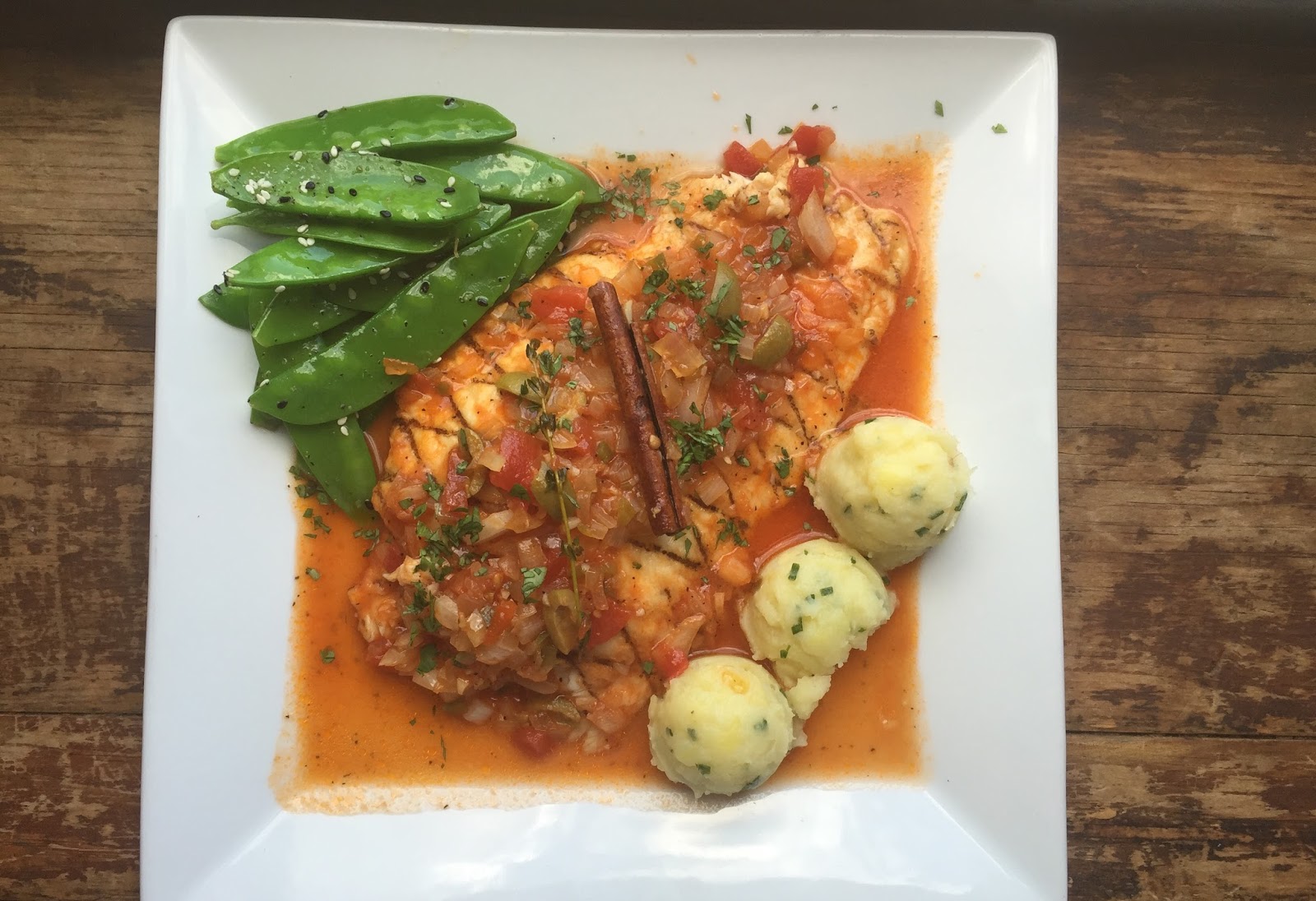
Another dish we did on Friday (delayed post) was a Vera Cruz. This was one of the (many) times that Chef has given all of us an entree to make and told us that we have to have a complete dish by the end of the day. So, on top of a new recipe we're making, we need two other dishes to worry about as well.
One of the hardest things to do in the kitchen (according to Chef) is to grill a fillet of fish. So, he gave us the option to saute the fish or bake it, but you know me, I needed to tackle the grill. I wanted to get the grill marks to come through on the dish. Also, I wanted to try the challenge of grilling a very delicate piece of fish. Game on.
So, I dredged the fish in flour, shook off the excess, and then dipped it in a bit of high temperature oil. Then, my heart started pounding and my hands started shaking. Keep the fish on for 2 seconds too long, and it'll fall apart on grill, Chef said. With his voice echoing in my head, I put the fish on the grill and counted to twenty, gently picked it up with tongs and cross hatched it for another twenty, quickly took it off the grill, onto a sizzle plate, and into the oven.
We started the sauce which has a tomato base, some cinnamon sticks, olives, and capers. It had some interesting mixture, to say the least. We got the sauce going in a pan, and once it was boiling, took the fish out of the oven and sent it for one final swim.
My finished plate looked like this:
Notice the grill marks, please. I worked very hard on them. For a full forty seconds. Also pictured: celery root and potato mash with chives and sesame oiled sugar snap peas.
Tip of the day: When grilling fish. Don't mess up. Work quickly and gently. You only have to grill one side (the presentation side). When putting the fish on the grill, make sure to put it presentation side down. This means that the skin side will be on top. Always season your flour before breading any protein. Salt, pepper, and an herb should do the trick.
On day 1, Chef did a demo of a salt crusted sea bass. I can't imagine anyone actually makes this at home, but it is a great technique and a really great table side presentation.
First, we toasted crushed black peppercorns and coriander seeds. Then, we coated the inside of the (whole) striped bass with the spice mixture. We then placed sliced lemons and fennel inside the fish cavity.
Here comes the good party. We mixed an ENTIRE box of kosher salt (read: an entire box of kosher salt) with a couple of egg whites to help hold the mixture together, and lined the pan with some salt. We placed the fish on top of the salt and then completely smothered the fish with the salt mixture.
When the fish is cooking in the oven, it's not baking. It's steaming. The salt creates a seal and ends up steaming the fish inside. After it's out of the oven, you peel off the salt and take out the fennel and lemon, and serve the fish that's been steamed. And, spoiler alert: The fish is not at all salty.
Another dish we did on Friday (delayed post) was a Vera Cruz. This was one of the (many) times that Chef has given all of us an entree to make and told us that we have to have a complete dish by the end of the day. So, on top of a new recipe we're making, we need two other dishes to worry about as well.
One of the hardest things to do in the kitchen (according to Chef) is to grill a fillet of fish. So, he gave us the option to saute the fish or bake it, but you know me, I needed to tackle the grill. I wanted to get the grill marks to come through on the dish. Also, I wanted to try the challenge of grilling a very delicate piece of fish. Game on.
So, I dredged the fish in flour, shook off the excess, and then dipped it in a bit of high temperature oil. Then, my heart started pounding and my hands started shaking. Keep the fish on for 2 seconds too long, and it'll fall apart on grill, Chef said. With his voice echoing in my head, I put the fish on the grill and counted to twenty, gently picked it up with tongs and cross hatched it for another twenty, quickly took it off the grill, onto a sizzle plate, and into the oven.
We started the sauce which has a tomato base, some cinnamon sticks, olives, and capers. It had some interesting mixture, to say the least. We got the sauce going in a pan, and once it was boiling, took the fish out of the oven and sent it for one final swim.
My finished plate looked like this:
Notice the grill marks, please. I worked very hard on them. For a full forty seconds. Also pictured: celery root and potato mash with chives and sesame oiled sugar snap peas.
Tip of the day: When grilling fish. Don't mess up. Work quickly and gently. You only have to grill one side (the presentation side). When putting the fish on the grill, make sure to put it presentation side down. This means that the skin side will be on top. Always season your flour before breading any protein. Salt, pepper, and an herb should do the trick.
Sunday, July 26, 2015
If you can't take the fish, get out of the kitchen
Fish day. Gross, right? Well, gross for a reason different than you think. When Chef told us that fish day(s) were coming up, we all made the face. The same face you're probably making right now when you're thinking, "Ugh, really? I have to read about fish for the next couple of days?"
Turns out, fish only smells like fish when it's not fresh. So, I walked in on Thursday morning thinking the place was going to reek of fish, but I was so wrong! We had the whole room filled with whole, striped bass, and the place didn't smell at all! Promise.
The first thing we did was meet our fish.
Poor guy, never saw it coming. I'm not going to show you the "after" pictures, because it's pretty gross, but trust me: I. Filleted. This. Fish.
On day 1, my buddy and I were asked to make a ceviche. Well, I think we kinda volunteered. I was interested in making it since I'd never had ceviche before.
For those of you who don't know, a ceviche is, essentially, raw fish which is marinated in an acid that cooks the fish. The texture of the fish in a ceviche is like raw fish, so if you're not into that, I don't think ceviche is for you.
The recipe for the ceviche is similar to that of a pico de gallo: diced onions, tomatoes, serrano pepper, and, of course, lots and lots of lime juice.
First, the fish was marinated by itself in the lime juice, for about an hour. Then, we added the mise en place and it continued to marinate together.
One of my classmates walked in on fish day and told Chef, "Chef, I'll cook the fish, but I really really don't like fish at all. It's so fishy." Without even blinking he said, "you've been eating old fish." By the end of day 2, she said, "Chef, I can't believe you made me like fish."
Tip of the day: We've already spoken about the freshness of fish. If you want to buy fresh fish, don't buy the stuff that smells like fish. For the freshest fish, go to a fish market or store, look for a whole fish with the reddest gills, and ask them to fillet it for you. That way, you know exactly what you're getting. Often times the fish you get at the supermarket can be close to two weeks old.
Turns out, fish only smells like fish when it's not fresh. So, I walked in on Thursday morning thinking the place was going to reek of fish, but I was so wrong! We had the whole room filled with whole, striped bass, and the place didn't smell at all! Promise.
The first thing we did was meet our fish.
Poor guy, never saw it coming. I'm not going to show you the "after" pictures, because it's pretty gross, but trust me: I. Filleted. This. Fish.
On day 1, my buddy and I were asked to make a ceviche. Well, I think we kinda volunteered. I was interested in making it since I'd never had ceviche before.
For those of you who don't know, a ceviche is, essentially, raw fish which is marinated in an acid that cooks the fish. The texture of the fish in a ceviche is like raw fish, so if you're not into that, I don't think ceviche is for you.
The recipe for the ceviche is similar to that of a pico de gallo: diced onions, tomatoes, serrano pepper, and, of course, lots and lots of lime juice.
First, the fish was marinated by itself in the lime juice, for about an hour. Then, we added the mise en place and it continued to marinate together.
One of my classmates walked in on fish day and told Chef, "Chef, I'll cook the fish, but I really really don't like fish at all. It's so fishy." Without even blinking he said, "you've been eating old fish." By the end of day 2, she said, "Chef, I can't believe you made me like fish."
Tip of the day: We've already spoken about the freshness of fish. If you want to buy fresh fish, don't buy the stuff that smells like fish. For the freshest fish, go to a fish market or store, look for a whole fish with the reddest gills, and ask them to fillet it for you. That way, you know exactly what you're getting. Often times the fish you get at the supermarket can be close to two weeks old.
Home in time for the Hollandaise
We continued last week (sorry for the late post) with no meat, since the 9 days end today (yay!). After learning about emulsions (temporary and permanent) we needed to learn about the classic Hollandaise and Béarnaise sauces.
The largest part of a Hollandaise is butter, so the success or failure of the sauce depends not only on skillfully combining egg yolks, water, acid, and butter into a rich, creamy sauce, but also on the quality of the butter itself. Unfortunately, we could only use clarified margarine, since we cook in a meat kitchen, and Jewish law prohibits cooking meat and dairy together. Even though we used margarine, we still got the idea of the sauce. I was really excited to be making it since it's something that I've never had before. Little did I know that this was going to be quite the workout.
In general, the ratio of egg to butter is 1 yolk to every 2-3 ounces of butter. The more eggs you have, the more butter the sauce can handle.
An acid is also added to the sauce for flavor and to help the eggs hold the butter together. The acid can be either a vinegar reduction and/or lemon juice. In our case, we used both. We reduced the vinegar with peppercorns to make a strong, concentrated flavor.
And then, the real work started. I combined a few egg yolks and started whisking them in a large metal bowl by hand. Slowly, I added the vinegar reduction and (continuously whisking) brought the bowl over to a pot of boiling water. I rested the bowl on the pot of water and continued to furiously whisk the eggs and reduction. It was really tricky because you don't want your bowl to get too hot that the eggs start to cook; we don't want to have scrambled eggs on our hands. You also don't want to mixture to cool off too much, either. So it was an aerobic effort to keep my eggs at the desired temperature. On, off, whisk, on, whisk, off, on, whisk. I was so tired. My arm was killing, my wrist was aching, but I did NOT want to be the one who broke a hollandaise. Chef said he was going to make an example out of the broken sauce and show us how to fix it. But I certainly did not want mine to be the example.
Once I got the eggs thick enough (like ribbons, whatever that means), it was time to add the butter. (I'll just call it butter here even though we used margarine, because, gross). I had the measured out butter next to me and, while whisking with my right hand, I slowly streamed in the butter with my left, making sure that as soon as the butter hit the eggs, it was whisked in immediately. As I was whisking, I noticed my sauce was a little thick, so I added a few drops of boiling water just to thin it out a little. Finally, I was able to stop whisking. I tasted and added salt and a little cayenne pepper, and squeezed some fresh lemon juice in there as well. Because we were using margarine, the taste really came through, so I used more vinegar reduction than was suggested, and I squeezed a bit more lemon at the end, and I really liked the result. It was a bit less "margarine-y" than the others.
A Béarnaise sauce, while very similar to the Hollandaise, has a tarragon and vinegar reduction, and with white wine instead of lemon juice.
We also got started on a risotto, which is a rice that needs love for 25 minutes straight. We used dried shitake mushrooms, and placed them in a bowl with boiling water and consume mix (so it would remain parve).
I sauteed finely diced onions in a saute pan for a minute or two, and then added the rice. I mixed the rice until it started to toast a little, and then slowly added the consume/mushroom water (without the mushrooms). I added a cup at a time, and continued to mix the rice until the liquid was absorbed, and then I added another cup, absorbed, and repeated.
I added the mushrooms once the rice was tender, and also added a splash on truffle oil for the aroma. Seasoned with salt and pepper and turned off the heat.
Meanwhile, I had blanched some broccoli rabe, which is naturally very bitter tasting. The bitterness can be removed by adding some acid, like lemon juice, and I added some crushed red pepper flakes, too. The broccoli rabe was chopped up and reserved to be put on top of the mushroom risotto.
This is a nice vegetarian dish that I can make for all of my vegetarian friends. I do have a few. Hi girls!
Tip of the day: When whisking a Hollandaise or a Béarnaise, you're arm is going to want to fall off if you use your upper arm strength to mix. The trick is, it's all in the wrist. This goes for pretty much any whisking work you'll need to do by hand, not just for a Hollandaise. Use your wrist for all of the whisking and you'll be able to stand it for much longer.
The largest part of a Hollandaise is butter, so the success or failure of the sauce depends not only on skillfully combining egg yolks, water, acid, and butter into a rich, creamy sauce, but also on the quality of the butter itself. Unfortunately, we could only use clarified margarine, since we cook in a meat kitchen, and Jewish law prohibits cooking meat and dairy together. Even though we used margarine, we still got the idea of the sauce. I was really excited to be making it since it's something that I've never had before. Little did I know that this was going to be quite the workout.
In general, the ratio of egg to butter is 1 yolk to every 2-3 ounces of butter. The more eggs you have, the more butter the sauce can handle.
An acid is also added to the sauce for flavor and to help the eggs hold the butter together. The acid can be either a vinegar reduction and/or lemon juice. In our case, we used both. We reduced the vinegar with peppercorns to make a strong, concentrated flavor.
And then, the real work started. I combined a few egg yolks and started whisking them in a large metal bowl by hand. Slowly, I added the vinegar reduction and (continuously whisking) brought the bowl over to a pot of boiling water. I rested the bowl on the pot of water and continued to furiously whisk the eggs and reduction. It was really tricky because you don't want your bowl to get too hot that the eggs start to cook; we don't want to have scrambled eggs on our hands. You also don't want to mixture to cool off too much, either. So it was an aerobic effort to keep my eggs at the desired temperature. On, off, whisk, on, whisk, off, on, whisk. I was so tired. My arm was killing, my wrist was aching, but I did NOT want to be the one who broke a hollandaise. Chef said he was going to make an example out of the broken sauce and show us how to fix it. But I certainly did not want mine to be the example.
Once I got the eggs thick enough (like ribbons, whatever that means), it was time to add the butter. (I'll just call it butter here even though we used margarine, because, gross). I had the measured out butter next to me and, while whisking with my right hand, I slowly streamed in the butter with my left, making sure that as soon as the butter hit the eggs, it was whisked in immediately. As I was whisking, I noticed my sauce was a little thick, so I added a few drops of boiling water just to thin it out a little. Finally, I was able to stop whisking. I tasted and added salt and a little cayenne pepper, and squeezed some fresh lemon juice in there as well. Because we were using margarine, the taste really came through, so I used more vinegar reduction than was suggested, and I squeezed a bit more lemon at the end, and I really liked the result. It was a bit less "margarine-y" than the others.
A Béarnaise sauce, while very similar to the Hollandaise, has a tarragon and vinegar reduction, and with white wine instead of lemon juice.
We also got started on a risotto, which is a rice that needs love for 25 minutes straight. We used dried shitake mushrooms, and placed them in a bowl with boiling water and consume mix (so it would remain parve).
I sauteed finely diced onions in a saute pan for a minute or two, and then added the rice. I mixed the rice until it started to toast a little, and then slowly added the consume/mushroom water (without the mushrooms). I added a cup at a time, and continued to mix the rice until the liquid was absorbed, and then I added another cup, absorbed, and repeated.
I added the mushrooms once the rice was tender, and also added a splash on truffle oil for the aroma. Seasoned with salt and pepper and turned off the heat.
Meanwhile, I had blanched some broccoli rabe, which is naturally very bitter tasting. The bitterness can be removed by adding some acid, like lemon juice, and I added some crushed red pepper flakes, too. The broccoli rabe was chopped up and reserved to be put on top of the mushroom risotto.
This is a nice vegetarian dish that I can make for all of my vegetarian friends. I do have a few. Hi girls!
Tip of the day: When whisking a Hollandaise or a Béarnaise, you're arm is going to want to fall off if you use your upper arm strength to mix. The trick is, it's all in the wrist. This goes for pretty much any whisking work you'll need to do by hand, not just for a Hollandaise. Use your wrist for all of the whisking and you'll be able to stand it for much longer.
Subscribe to:
Posts (Atom)